The clear answer: Arteris Plus contains five core ingredients: passion flower, prickly pear (100 mg), corydalis, marshmallow root and California poppy seeds. Prickly pear has the strongest cardiovascular evidence and supplies helpful minerals; passion flower and California poppy work on stress and sleep; corydalis and marshmallow root are more traditional additions. Only prickly pear's dose is disclosed.
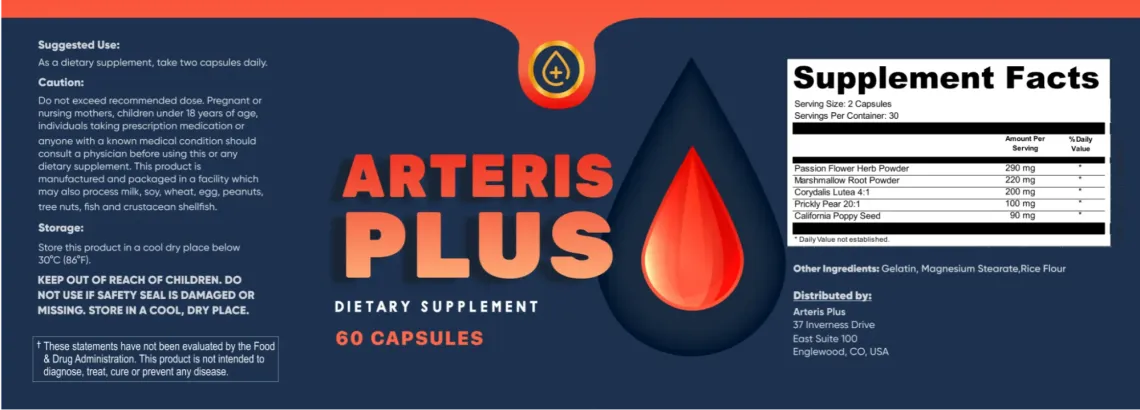
Here is the full formula, examined without the marketing gloss. For each ingredient we give the traditional rationale, the actual evidence, and an balanced read on how much it likely contributes.
1. Passion Flower (Passiflora incarnata)
The formula's lead calming botanical. Passiflora incarnata is one of the best-studied herbal sedatives, with randomized evidence for reducing anxiety (PMID 24140586). Because acute stress raises blood pressure through sympathetic activation, an ingredient that promotes calm can help reduce stress-driven spikes. It's important to be precise here: passion flower's blood-pressure evidence is largely indirect — it works on the stress pathway rather than being a proven antihypertensive on its own.
2. Prickly Pear (Opuntia ficus-indica) — 100 mg
The ingredient with the most direct cardiovascular trial evidence in this formula. A systematic review and meta-analysis of randomized trials found Opuntia ficus-indica produced significant reductions in body fat, blood pressure and total cholesterol (PMID 25837206). It's rich in the minerals — potassium, magnesium and calcium — that have their own established role in blood-pressure regulation, plus betalain and polyphenol antioxidants.
3. Corydalis
A plant in the poppy family traditionally used for pain and circulation. Corydalis contains alkaloids studied mainly for analgesic and antispasmodic activity; some traditional and preliminary sources describe vasodilatory and smooth-muscle-relaxing effects that could theoretically support circulation. The balanced position: robust human blood-pressure trials on corydalis are lacking, so its inclusion rests more on traditional use than on strong clinical evidence.
4. Marshmallow Root (Althaea officinalis)
A demulcent herb valued mainly for soothing mucous membranes and supporting digestion. Marshmallow root supplies some potassium and has anti-inflammatory properties, and better nutrient absorption indirectly supports cardiovascular nutrition. Its direct blood-pressure evidence is limited — it is best understood as a supportive, well-tolerated ingredient rather than a primary blood-pressure actor.
5. California Poppy Seeds (Eschscholzia californica)
A gentle relaxant from the poppy family, traditionally used to support sleep and ease tension. Like passion flower, its relevance to blood pressure is chiefly through the calming, GABA-supporting pathway — reducing the stress and poor sleep that elevate blood pressure — rather than through a direct antihypertensive mechanism. Human blood-pressure trials specific to California poppy are limited.
The minerals behind prickly pear
Much of prickly pear's plausibility comes from its mineral content. Potassium helps the body balance sodium and relax vessel walls, with a randomized-trial dose-response behind it (PMID 32500831; PMID 9168293). Magnesium acts as a natural calcium-channel modulator supporting vessel relaxation (PMID 27402922). The caveat: the amount of these minerals delivered by 100 mg of prickly pear extract is modest compared with the doses used in those trials.
The disclosure problem, stated plainly
Beyond prickly pear's 100 mg, Arteris Plus doesn't publish the amount of each herb. That matters: an ingredient present only in a token amount can't do much, and without the numbers you can't tell. A clear label would list each botanical's milligrams. Treat the undisclosed doses as a genuine limitation when weighing this product.
Safety note: Several of these botanicals (passion flower, California poppy) are sedative and mildly hypotensive, and prickly pear can lower blood sugar. If you take blood-pressure medication, sedatives, sleep aids or diabetes medication, talk to your doctor before use, and never stop prescribed medication.
Scientific References (PubMed)
Miroddi M, et al. (2013) "Passiflora incarnata L.: ethnopharmacology, clinical application, safety and evaluation of clinical trials." J Ethnopharmacol. PMID: 24140586
Onakpoya IJ, et al. (2015) "The effect of cactus pear (Opuntia ficus-indica) on body weight and cardiovascular risk factors: a systematic review and meta-analysis of randomized clinical trials." Nutrition. PMID: 25837206
Filippini T, et al. (2020) "Potassium intake and blood pressure: a dose-response meta-analysis of randomized controlled trials." J Am Heart Assoc. PMID: 32500831
Zhang X, et al. (2016) "Effects of magnesium supplementation on blood pressure: a meta-analysis of randomized double-blind placebo-controlled trials." Hypertension. PMID: 27402922
Whelton PK, et al. (1997) "Effects of oral potassium on blood pressure: meta-analysis of randomized controlled clinical trials." JAMA. PMID: 9168293
These citations refer to research on general blood-pressure nutrition and the individual ingredients, not to the Arteris Plus product itself, which has not undergone its own clinical trial. Studies often use doses or preparations different from those in this formula. This content is educational and not medical advice; Arteris Plus is not intended to diagnose, treat, cure or prevent any disease.